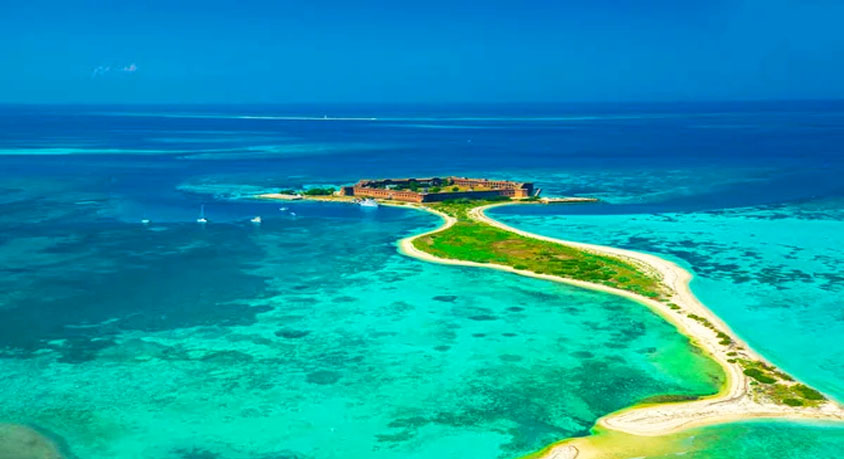
After the Florida Keys finally sink below the horizon, you’re left with nothing but water so blue it looks like someone dumped a tanker of pool chemicals into the Gulf. You sit there on the Yankee Freedom ferry for another forty minutes, nursing a lukewarm coffee and wondering if you’ve just made a $200 mistake, and then it appears: a colossal brick fortress rising straight out of the waves.
Sixteen million bricks, rows of cannons, and a literal moat—all sitting seventy miles into the middle of nowhere. This is Fort Jefferson in Dry Tortugas National Park. It’s easily the most absurdly beautiful place in the entire U.S. Park System, yet because of the logistics, almost nobody actually sees it. It’s a ghost town of mid-19th-century military ambition, built on a sandbar so remote that just getting there feels like an expedition.
Like most people who look at a Florida map, I always figured the world ended at Key West. You hit the southernmost buoy, take the mandatory selfie, the road stops, and that’s it. For years, I assumed the Dry Tortugas were just some obscure historical footnote reserved for hardcore sailors with serious boats. I was wrong. By booking a ferry ticket on a whim, I found a spot that feels more like the remote, untouched Caribbean than the Florida I know. It’s Civil War history wrapped in neon-turquoise water, all sitting comfortably within a single day trip from the tourist-heavy sprawl of Duval Street.
The ferry will set you back about $190. At first, that price tag made me wince—it’s not cheap for a day out. But here’s how I justified it once I was actually on the island:
The ticket includes your breakfast, a buffet lunch, and the use of snorkel gear.
You’re getting a five-hour round-trip boat ride through some of the clearest, wildest water on earth, plus full access to a historical site that usually takes a private charter to reach.
Compare that to a day at a major theme park—where you’ll drop $150 just to stand in 90-minute lines under the Florida sun and pay $12 for a mediocre, soggy burger—and suddenly, the ferry starts to feel like a steal.
While the boat lunch is decent—think basic deli sandwiches, fruit, chips, and cookies—it’s a "first come, first served" buffet and it disappears fast. I learned to bring my own "survival bag" of beef jerky, extra Gatorade, and a few high-protein granola bars. Trust me, after two hours of snorkeling in the current, you’ll be ravenous, and those extras will taste like a five-star meal.
Key West hotels are a total racket. You’ll pay $300 a night for a room the size of a walk-in closet just because it has "island charm." I chose to stay further up the chain in Marathon and drove down early for the 7:30 a.m. ferry departure. It saved me roughly $150 a night, and the drive through the Keys in the pre-dawn light is actually pretty spectacular.
As for the island itself, you can camp for $15, but it’s primitive as it gets. There’s no running water, no showers, and you have to haul every single thing you need—food, water, gear—onto the ferry yourself. Unless you’re a die-hard stargazer or a glutton for extreme isolation, stick to the day trip. The logistics of camping here require a level of commitment that most casual travelers just aren't prepared for.
The Fort is the main draw—walking the moat wall felt like stepping onto a forgotten movie set—but the real magic happens once you hit the water.
The Snorkeling: They hand you masks and fins on the boat. Don't waste time sitting on the beach; head straight for the south side of the moat wall. The water clarity is staggering. I saw sea turtles that didn't even bother to move when I floated by, and schools of reef fish so bright they looked like they’d been painted with highlighters.
The Birds: If you walk to the far western tip of the island, the crowds from the boat vanish entirely. In the spring, the sky is thick with sooty terns. It’s loud, it’s wild, and it feels like you’ve reached the literal edge of the world.
My "Lessons Learned" (The Hard Way). Take the Dramamine. I saw three people on my boat lose their breakfast because the Gulf got choppy. Don't wait until you're on the boat; take it an hour before you board, or you'll spend the ride staring at the horizon and regretting your life choices.
There is zero shade once you leave the fort walls. I applied SPF 50 twice and still came back with a "ferry tan" that lasted for weeks. Wear long sleeves if you have them.
Go in March or April. The humidity hasn't turned the fort into a brick oven yet, and the water is warm enough to stay in for hours without shivering.