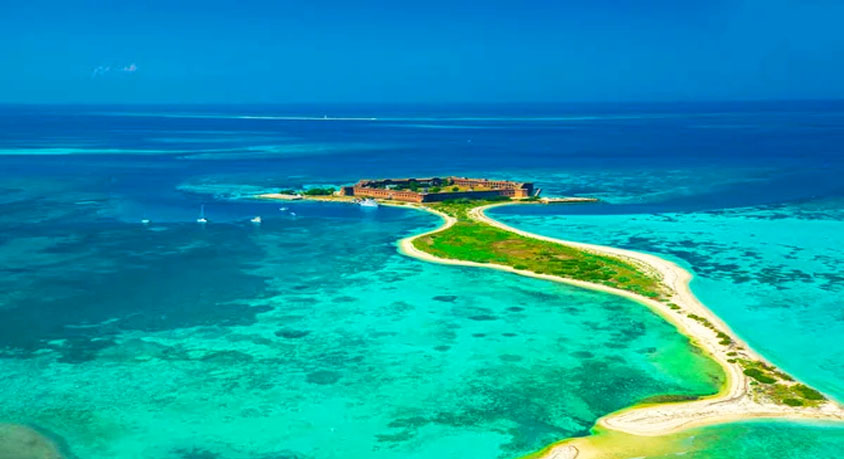
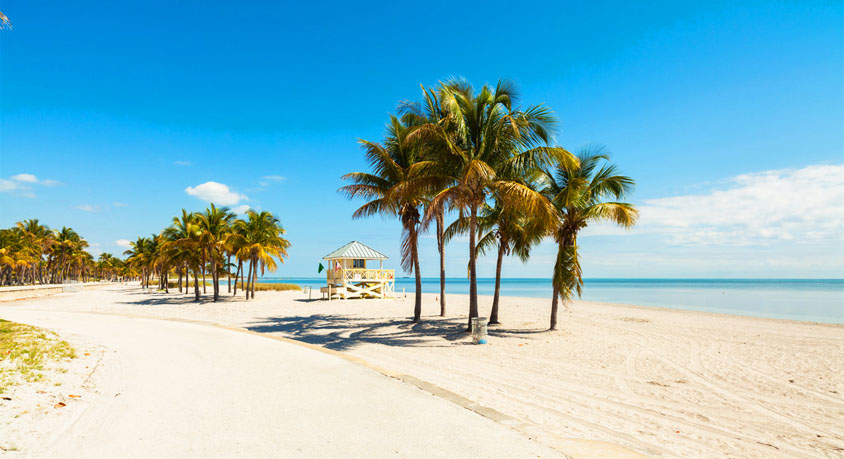
You're driving south on the Rickenbacker Causeway, the Miami skyline dancing in your rearview mirror, when the road narrows and the world shifts from urban chaos to coastal calm. The billboards for South Beach clubs and overpriced champagne brunches fade, replaced by sea grapes and the salt-tinged breeze. At the very end of Key Biscayne, past the lighthouse and the crowded public beaches, a barely marked dirt track disappears into a tangle of mangroves. This is the path to something most tourists don't even know exists: a sliver of sand where the only sounds are waves and the occasional pelican dive-bombing for lunch.
The assumption, drilled into anyone who's ever seen a Miami travel commercial, is that a beautiful, quiet beach here requires a private condo key or a five-star hotel room key. I drove past the packed parking lots, ready to settle for another crowded stretch of shore. What I found, by following that unpromising dirt road, was proof that Miami still holds secrets—and they're free for anyone willing to look a little foolish pushing through mangrove branches.
The moment you emerge from the red mangrove tunnel onto the hidden beach, the cost calculation shifts dramatically. South Beach's famous stretch demands $30-$50 for parking alone if you arrive after noon, plus another $15 for two mediocre cocktails from a beachside vendor, plus the psychic cost of sharing your towel with a thousand hungover spring breakers.
Here, parking is free if you arrive early enough to claim one of the dozen informal spots along the roadside before the rangers notice. There are no vendors, no chair rentals, no jet ski operators hawking $100 tours. Your only expense is what you bring. This is where preparation becomes profit.
The nearest decent food is back on Key Biscayne's main strip, Crandon Boulevard, where local Cuban cafes sell authentic medianoche sandwiches for $8 and cafecitos for $2, a fraction of what you'd pay for a sad turkey wrap at a tourist beach shack. Pack these in your collapsible cooler bag, and you've just engineered a beach day that costs less than a single frozen drink at Nikki Beach.
For accommodation, the math is brutal but freeing. A mid-range hotel on Key Biscayne itself, like the Ritz-Carlton or the Silver Sands Beach Resort, starts at $400-$600 a night—roughly what you'd pay for a week at a perfectly nice beach town in the Carolinas. The smart money stays in downtown Miami or Coconut Grove, where the same $200-$250 secures a clean, modern room, and the 20-minute drive across the causeway becomes part of the adventure rather than a daily commute.
Transportation here is car-dependent, but with a twist. The Rickenbacker Causeway toll is a modest $2.25 each way, a rounding error compared to the $50 you'd spend on ride-share from Miami Beach. The hidden cost to avoid is the parking ticket; those informal roadside spots fill by 9 a.m., and the rangers patrol with quiet efficiency after that. If you arrive late, the official lot at Bill Baggs Cape Florida State Park charges $8 for the day—still a bargain, but a reminder that secrets have capacity limits.
While the hidden beach itself is the prize, the real discovery is how it connects to a constellation of overlooked experiences within walking distance. A ten-minute walk south along the shore, past the erosion barriers and the nesting shorebirds, brings you to the base of the Cape Florida Lighthouse. Most tourists pay the $2 admission and climb the 109 steps for the panoramic view, but the savvy visitor arrives at sunset, when the lighthouse grounds close but the beach below remains open. Lying on the sand, watching the sky turn pink and purple behind the white tower while the lighthouse beam begins its nightly sweep, is an experience no ticket can buy.
On the bay side of the key, a five-minute drive leads to the quiet expanse of Hobie Island Beach. This overlooked stretch faces downtown Miami across the water, offering a completely different perspective: the skyline glittering at dusk, container ships gliding silently past, and water shallow enough to wade out a hundred yards. It's where local families come for weekend barbecues, and where you can float on your back watching the city that feels, from this angle, like a distant postcard. For a final dose of hidden culture, the nearby Cape Florida Pavilion rents kayaks for reasonable hourly rates, but the real trick is to bring your own inflatable paddleboard ($300 at a big-box store, pays for itself in three uses) and explore the mangrove-lined channels at high tide. These narrow waterways, invisible from the shore, open into secret lagoons where herons stand like statues and the only sound is your paddle dipping into glassy water.
Planning a visit between March and June requires reading Florida's seasonal clock like a local. March delivers spring break crowds to the main beaches, which paradoxically makes the hidden beach more valuable. The masses flock to the obvious spots with amenities and lifeguards, leaving the secret shore to those willing to walk a little further and pack a little smarter. The water in March is still brisk but refreshing, and the humidity hasn't yet become oppressive. April and May offer the sweet spot: reliably warm days, minimal rain, and the spring break chaos replaced by a calmer, more local vibe. By late May and June, the heat and afternoon thunderstorms arrive with regularity. Morning visits become essential, as storms typically roll in by 2 p.m. and clear by late afternoon, leaving behind washed-clean air and spectacular sunset potential.
Your major cost is the flight into Miami International Airport (MIA). A less obvious but often cheaper option is Fort Lauderdale-Hollywood International (FLL), about 45 minutes north, where budget carriers offer competitive fares and the drive down A1A along the coast serves as a scenic warm-up for your beach adventures. Pack a rash guard or lightweight long-sleeve shirt; even in spring, the Florida sun is deceptively intense, and shade on this hidden beach is provided solely by your own ingenuity with an umbrella or a well-positioned sea grape tree.