You’ve seen the photos, and you’ve heard the whispers: a whimsical, tulip-shaped park plopped in the Hudson River, a futuristic spectacle that screams “Instagram trap.” The assumption, a perfectly logical one, is that such a brazenly beautiful and new thing in Manhattan must come with a brazenly high price tag—a cover charge, an outrageous concession stand, a mandatory donation. I approached Little Island with the skepticism of a New Yorker who’s been nickel-and-dimed by her own city one too many times, ready to expose it as a glorified, overpriced pier. What I found, especially when visited with the strategic timing of the shoulder seasons, was a masterclass in how to enjoy a multimillion-dollar urban marvel for the price of a subway ride and a bit of clever planning.
Step onto the undulating pathways and you're immediately surrounded by ingenious design, but your first financial test comes at the small concession kiosk. A gourmet ice pop here will set you back $7, and the artisanal snacks carry boutique markups. This is where the savvy visitor pivots. The park itself has no entrance fee—a fact that still surprises many. Your move is to pack a picnic. A ten-minute walk east lands you in the Chelsea Market or the nearby Trader Joe’s, where $15 can assemble a feast of cheeses, bread, and fruit far superior to any $15 “small plate” on the island. Enjoy it on the lush lawns with a billion-dollar view; the tables are free, the scenery is included. Thinking about staying nearby? A standard hotel room in the adjacent Meatpacking District can easily crest $400 a night. For that same amount in, say, suburban Kansas City, you’d get a sprawling suite. Here, a better bet is a hotel further west in Chelsea or even across the river in Jersey City, where rates dip to a more palatable $200-$250, and you’re just a short, scenic ferry ride ($7) away from the park’s doorstep. The true beauty of Little Island’s location is its walkability. It’s seamlessly connected to the Hudson River Greenway, and the 14th Street subway station (A, C, E, L) is a flat, ten-minute stroll. There are no hidden “park access” fees, no mandatory tram rides—just your own two feet and the city’s grid.
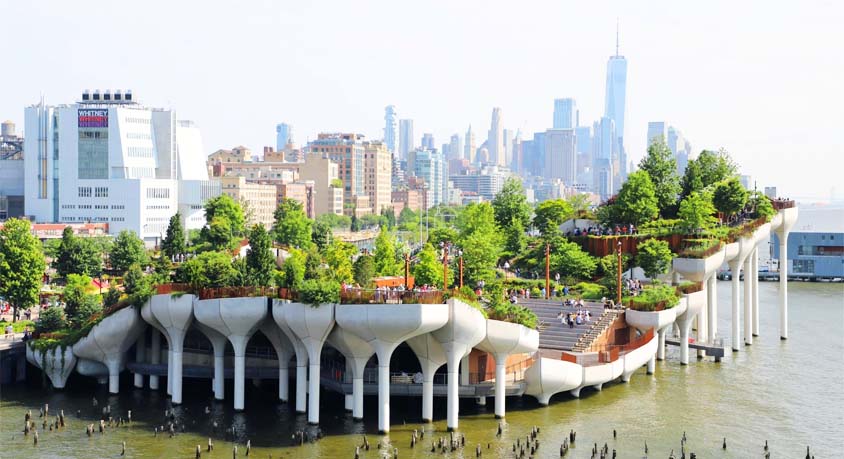
While crowds cluster around the main amphitheater and the highest overlooks, the real magic hides in plain sight. Visit early on a weekday morning, just after sunrise, and you’ll have the park’s lower, more intimate pathways nearly to yourself. The sound of water lapping against the concrete pilings beneath your feet is meditative, a stark contrast to the daytime buzz. For a completely different cultural hit, cross the connecting bridge back to the mainland and explore the semi-hidden stretch of the Old Pier 54, the historic Cunard Line pier foundation just north of the island. It’s a raw, industrial counterpoint to Little Island’s curated beauty, where you can see remnants of maritime history being slowly reclaimed by the river, all for free. And instead of just visiting the island, make it the centerpiece of a self-guided waterfront architecture tour. Walk south to the Whitney Museum’s striking building, or north to the intricate facade of the Starrett-Lehigh Building, using the island as your surreal, floating midpoint.
Planning a visit between February and June requires embracing the river’s mood swings. In February and March, the island is a windswept, dramatic outpost. The evergreen sections provide structure, but the experience is bracing and often blissfully empty; you’re there for the architecture, not the picnics. Bundle up as if you’re on a boat—because you essentially are. April and May are the revelation. The park’s 350 species of plants begin to awaken, creating a tapestry of color, and the crowds, while present, are manageable on weekdays. This is the ideal time to experience the design in dialogue with nature. By June, the summer performance season kicks into gear, bringing energy but also peak afternoon congestion. Your major cost is the flight to New York. Once here, an off-peak flight into Newark (EWR) paired with a NJ Transit train to Penn Station can sometimes be cheaper than flying directly into LaGuardia or JFK. From midtown, it’s a straightforward, inexpensive subway or cab ride downtown. Always carry a light layer; the Hudson River breeze is a constant, cooling companion that can turn chilly even on a sunny June afternoon.
Little Island proves that in New York, the most audacious dreams can be experienced not through a hefty ticket, but through a shift in perspective and a picnic packed with intention.