The trail winds through moss-draped maples and giant ferns, the kind of forest that makes you expect a unicorn to step out from behind a cedar. Rain drips gently from the canopy, and the only sound is the rush of the Sol Duc River somewhere ahead. Then you smell it: sulfur, faint but unmistakable, rising from a series of pools tucked into the riverbank where steam curls upward through the trees. You strip down to your swimsuit, ease yourself into water hot enough to make you gasp, and lean back against a rock while the forest does its rain thing all around you. You have not paid $50 for a day pass. You have not booked a spa appointment months in advance. You have just discovered why the locals keep the backcountry hot springs to themselves.
The assumption, shared by anyone who's ever priced a luxury spa getaway, is that soaking in natural hot water requires a credit card and a reservation. California's famous springs charge $80 for day use, $400 for a room, and you'll share the pool with people comparing investment portfolios. I booked a trip to Olympic National Park expecting to pay for the developed resort or skip the experience entirely. What I found, by asking a ranger the right question and hiking an extra mile, was hot water that costs nothing and feels like everything.
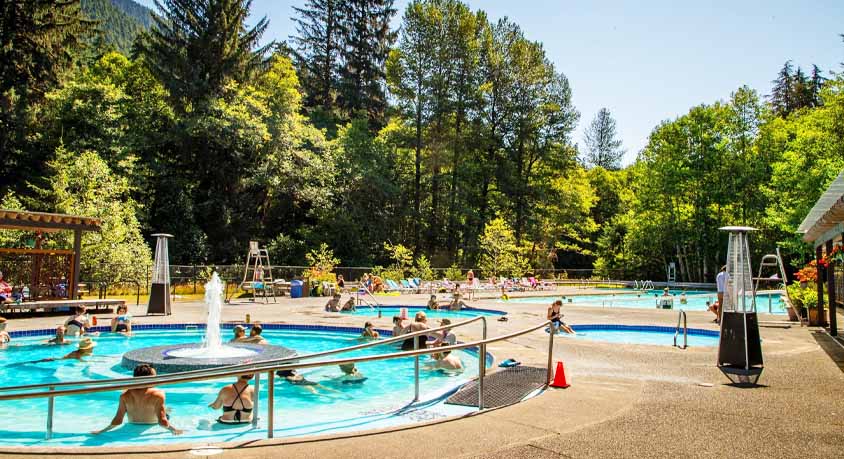
The moment you pull into the Sol Duc Hot Springs Resort parking lot, the financial options become clear. The resort charges $20 for day use of their three developed pools, $150-$250 for a cabin if you want to stay overnight. But the ranger at the visitor center mentioned something else, something not on the main maps: the backcountry hot springs, a series of natural pools along the river about a mile up the trail from the resort. No admission, no reservations, no chlorine. Just rocks rearranged by previous visitors to create pools of varying temperatures, all fed by the same geothermal water that fills the resort's pools.
The food situation around Sol Duc requires planning, which is exactly how you avoid resort pricing. The resort's Springs Restaurant serves decent food at predictable prices—$15 for a burger, $20 for salmon—but the local move is to stock up in Port Angeles before you drive into the park. The Safeway on East Front Street will sell you sandwich supplies, snacks, and drinks for a fraction of what you'll pay inside the park. A cooler full of food for two costs $30 and lasts multiple days. For a hot meal, the next town west is Forks, where the In Place Diner serves massive breakfasts and burgers for $8-$12, the kind of place where loggers and park employees actually eat.
For accommodation, the Sol Duc Resort cabins are the convenient choice at $150-$250 per night, but the budget play is the Fairholme Campground on Lake Crescent, 30 minutes east. A campsite there runs $24 per night, with access to flush toilets and potable water. The same money in a place like Calistoga might get you a parking spot. For those who prefer walls, the town of Port Angeles offers motel rooms for $100-$130 a night, and the drive through the park each morning is part of the experience.
Transportation to Sol Duc requires a car, which you already have if you're exploring Olympic National Park. From Seattle, it's a 3.5-hour drive including the ferry from Edmonds to Kingston, which saves driving around through Tacoma. The ferry costs $20 for car and driver, a bargain compared to the gas you'd burn going the long way. Once inside the park, the Sol Duc Road winds 14 miles from Highway 101 to the trailhead, paved and well-maintained. Parking at the resort lot is free, and the backcountry trail starts right behind the resort's cabins.
The main Sol Duc Falls trail draws most visitors, a paved path leading to a stunning waterfall where the river plunges through a narrow rock canyon. But the real discoveries lie on the less-traveled spur trails. Just before the falls, a faint path veers left toward the river, marked only by a small cairn. This is the way to the backcountry springs. Follow the river upstream for about half a mile, scrambling over rocks and roots, until you smell sulfur and see steam rising from the bank. The pools aren't marked, aren't maintained, and aren't guaranteed to be there—the river rearranges them every winter—but on any given day, you'll find a few gathered groups of rocks holding water hot enough to soak in.
For a completely different experience, continue past the backcountry springs to the Sol Duc Falls viewpoint, then take the Deer Lake Trail another mile into the backcountry. This section sees far fewer visitors, and the old-growth forest here is some of the park's most impressive. Massive western red cedars and Douglas firs tower overhead, their trunks wider than your car, and the understory is so green it almost glows. The trail eventually reaches Deer Lake, a pristine alpine lake where you can swim in summer, but even just the first mile is worth the hike.
The resort's developed pools have their place, especially after a long day of hiking when you want guaranteed hot water and a towel. The three pools range from 99 to 104 degrees, and the mineral content is high enough that you'll feel silky smooth afterward. But the real magic happens after the resort closes for the night, when the day-use visitors leave and the backcountry springs become accessible without the daytime crowds. A headlamp, careful footing, and the knowledge that you're soaking in water that rose from deep underground just hours before—that's an experience no spa can sell.
March at Sol Duc means snow at higher elevations and rain at lower ones. The backcountry springs are accessible but cold, and you'll appreciate the hot water more than you would in summer. Daytime highs reach the mid-40s, with overnight lows near freezing. April brings gradual warming, with highs in the low 50s and more rain than sun. The snow melts from the trails, and the waterfalls run full with spring melt. May and June push highs into the 60s, with longer days and the first real wildflowers. The crowds increase but never approach California levels, and the backcountry springs remain a locals-only secret for those willing to ask the right questions.
Your major cost is getting to Olympic National Park. From Seattle, budget $50 for gas and ferry, $100 if you're renting a car. From Portland, add an hour and $20 more. From anywhere else, fly into Seattle-Tacoma International and rent a car for the week. Pack layers that can handle rain and sun in the same hour, sturdy hiking shoes for the slick trails, and a swimsuit that you don't mind getting muddy. A headlamp is essential if you're planning evening soaks, and a dry bag will keep your clothes from getting wet on the hike in. Check road conditions before you go; the Sol Duc Road closes in winter but typically reopens by late March.