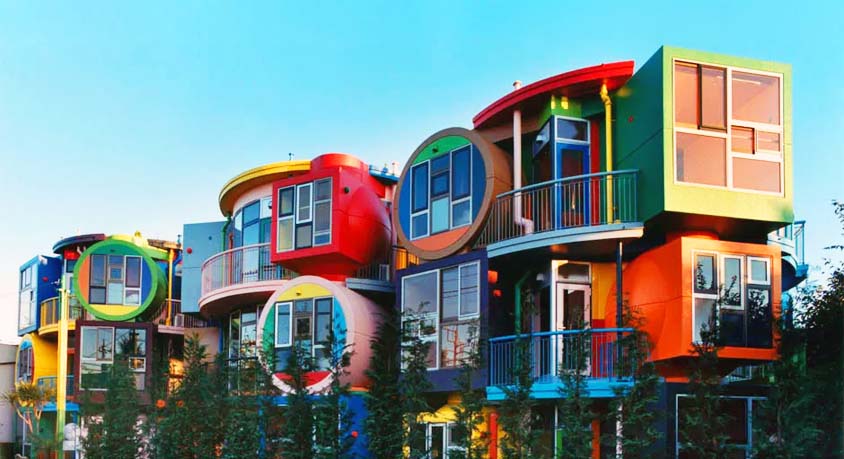
The American seeker of "weird Tokyo" is conditioned to expect one of two outcomes: a flawless, ticketed digital art museum where Instagram illusions are mass-produced, or a derelict back alley that's intriguing for three minutes before the anxiety of being lost sets in. When I heard about the Reversible Destiny Lofts in Mitaka—an architectural experiment designed to disorient and awaken the senses—I pictured a gated, private residence for wealthy iconoclasts, or worse, a derelict public art piece you could only view from behind a fence after a long, costly trek to the suburbs. I braced for a journey that would end in frustrated glimpses and a feeling of having been tricked by the internet. The reality was a meticulously managed, profoundly affordable, and uniquely interactive encounter with radical art, one that leveraged Tokyo's off-season and its culture of respectful reservation to offer an experience that felt priceless precisely because its price was so deliberately, almost defiantly, modest.
The financial architecture of visiting the Lofts is built on a fixed, transparent fee: a 1,000 yen (about $7) reservation deposit, refunded upon arrival, plus a 1,000 yen per person maintenance fee for the 90-minute tour. For under $15 total, you gain escorted, small-group access to a world that makes no economic sense. This isn't a gallery; it's someone's home, preserved as art. The immediate potential budget leak is assuming you need a taxi from Mitaka Station. You don't. It's a clearly signed 15-minute walk through a sleepy, affluent suburban neighborhood—a calming preamble that costs nothing. For food, the area around the station has fantastic, affordable options that locals use. Skip any place with an English menu board. Instead, find the tiny tonkatsu (pork cutlet) shop where a set lunch with miso soup, rice, and cabbage is 950 yen, or the standing udon counter where a steaming bowl is 500 yen. The price chasm is between the curated "experience" and the everyday excellence of Tokyo's suburban dining.
Accommodation during the January to April window in this part of Tokyo offers quiet value. The gleaming skyscraper hotels of Shinjuku feel distant. Instead, look at business hotels near Kichijoji or Mitaka stations. For the price of a dated airport hotel in a U.S. city, you get a spotless, compact room in a neighborhood brimming with local character, excellent parks, and direct train access to both the Lofts and central Tokyo. You are paying for a more authentic, less frantic version of the city. This location strategy is vital because transportation is the linchpin. Taking a taxi from Shinjuku would be a 5,000+ yen folly. The JR Chuo Line from Shinjuku to Mitaka takes 20 minutes and costs 340 yen with a transit card. The efficiency is breathtaking. The only "hidden fee" is the requirement to book your tour slot online well in advance—a small investment of planning that guarantees access and controls crowds.
The high-value, low-cost experience is not in taking quirky photos (which are restricted inside), but in the somatic sensation of the space. The tour requires you to remove your shoes and navigate uneven floors, protruding bumps, and strangely shaped rooms designed to force you into a state of conscious awareness. It is less about seeing and more about feeling architecture. For a free, complementary experience of curated oddity, visit the Ghibli Museum's exterior (also in Mitaka's Inokashira Park) if you can't secure tickets, or simply wander the stunning Inokashira Park itself, a massive green space with a boating pond, shrine, and zoo that offers a serene, natural counterbalance to the Lofts' artificial intensity. For a different kind of suburban discovery, walk from Mitaka to Kichijoji station via its shotengai (shopping streets), experiencing the laid-back, creative vibe of one of Tokyo's most desirable residential areas.
Targeting the first four months of the year is a strategic choice for contemplation. January and February are cold and clear, with stark light that emphasizes the Lofts' bold colors and plastic surfaces. The walk from the station is bracing but refreshing. Crowds are minimal, and you'll likely share the tour with only a handful of people. March and April bring the softness of plum and cherry blossoms to Inokashira Park, allowing you to pair the avant-garde with the classic in a single afternoon. The trade-off is the potential for cold or rain, requiring good layers. You are not visiting for perfect strolling weather, but for the sharp mental focus that cooler temperatures bring, enhancing the disorienting, thought-provoking nature of the visit itself. It’s art that demands engagement, not passive consumption.
The Reversible Destiny Lofts reject every premise of commercial tourism. They are not convenient, not photogenic in the typical sense, and not designed for mass appeal. Their value lies in that very resistance. The cost isn't in the 1,000 yen fee, but in the willingness to make a pilgrimage to a quiet neighborhood for an experience that can't be bought, only received—a rare reminder that Tokyo's most profound moments often lie in its deliberate, difficult, and deeply human contradictions.